One careless shortcut across a dune can crush plants that have spent years establishing themselves in shifting sand. At the Cresmina dunes near Guincho Beach, the simplest way to prevent that damage is also the best way to see the landscape: follow the designated boardwalk and marked access routes. This guide explains how to explore the Cresmina dunes boardwalk responsibly, what to wear, how Atlantic weather changes the visit and how to take photographs without trampling the very scenery you came to enjoy.
Why the Guincho dunes need a protected route
The dunes around Cresmina and Guincho form part of a living coastal system rather than a fixed bank of sand. Wind lifts grains from the beach and carries them inland, where low plants catch and hold some of the moving sand. Their roots help stabilise the surface, while the dunes provide a degree of protection for the ground behind them. The shape you see is therefore temporary. After a spell of strong wind, a ridge can look noticeably different, and sections of the walkway may collect blown sand.
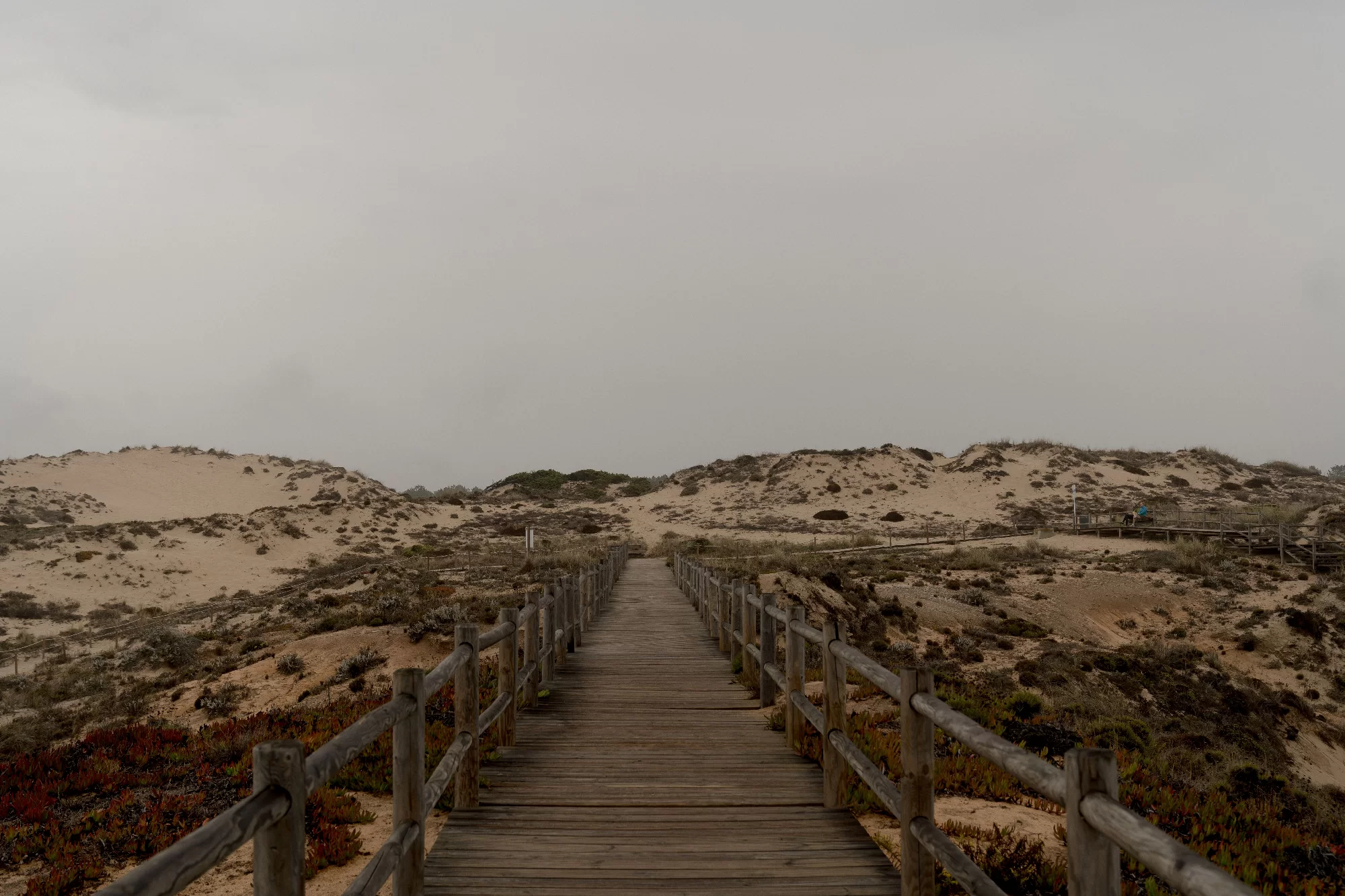
This movement helps explain why the Cresmina dunes boardwalk matters. It directs foot traffic over the sensitive ground instead of allowing dozens of informal tracks to cut through it. The route also gives visitors an elevated view across the pale sand, low vegetation and Atlantic coast without requiring anyone to climb a dune for a better angle. In a place defined by movement, the wooden structure creates a clear boundary: people have a route through, while the dunes retain room to change naturally.
The dune system lies near Guincho Beach in Cascais and within the Sintra-Cascais Natural Park. Although Guincho is often associated with surfing and strong wind, the dunes deserve attention in their own right. Look closely and the apparently empty sand becomes a patchwork of hardy plants, sheltered hollows and wind-made patterns. It is quieter and more interesting when you stop treating it as spare ground between the road and the beach.
At Cresmina, staying on the boardwalk is not a limitation; it is what allows the landscape to remain wild beside a busy coast.
How to use the Cresmina dunes boardwalk responsibly
Stay on the constructed route even if an unofficial trail appears to offer a quicker line or a clearer photograph. Repeated footsteps loosen sand and break vegetation, gradually turning one small shortcut into a broad scar. Bare patches are then more exposed to wind erosion. Children may need a quick explanation before setting out, especially because the soft slopes look inviting for running, sliding and digging.
Give other visitors enough room on narrower sections and avoid blocking the boardwalk while arranging group photographs. If you stop, move to a wider viewing area where one is available. Dogs should be managed closely and kept to designated access areas; local signs and current rules should guide you. A dog darting into the vegetation can disturb wildlife and create tracks that other visitors mistakenly follow.
Renting a bike here takes about two minutes at the counter, and it's usually the fastest way to actually do what's described above.
Book a Bike →- Use marked entrances. Do not climb over fencing or squeeze through gaps beside the path.
- Keep belongings secure. Plastic bags, food wrappers and light hats can disappear into the dunes quickly in a gust.
- Take all rubbish away. Small items such as tissues, bottle caps and snack packaging are especially easy to lose among the plants.
- Leave natural material in place. Plants, shells, stones and pieces of wood belong to the site, even when they seem insignificant.
- Respect temporary closures. A blocked section may be under repair or protecting an area affected by erosion.
Do not assume every sandy track is an approved path. Some are maintenance routes, while others have simply been made by people ignoring the main access. The boardwalk and official signs are the reliable guides. If windblown sand partly covers the wooden surface, continue along its visible direction rather than stepping sideways through vegetation to avoid getting sand in your shoes.
What to wear for sand, boards and Atlantic wind
You do not need hiking boots for a straightforward visit, but footwear should stay secure on your feet and provide reasonable grip. Trainers or light walking shoes are the most practical choice. Loose flip-flops can catch on wooden edges, offer little control on sandy sections and become awkward if strong wind forces you to brace yourself. After rain, boards may also be slippery, so shoes with a textured sole are preferable.
The exposed position near Guincho means clothing matters more than the distance might suggest. A bright, calm morning in central Cascais can feel cooler beside the dunes once the wind reaches the coast. Bring a light windproof layer rather than relying on a bulky sweater; it is easier to carry and much more effective against moving air. Sunglasses help with glare and blowing sand, while a hat needs a secure fit. Sunscreen remains sensible even on hazy days because there is very little shade along the open route.
Visitors with limited mobility, pushchairs or small children should expect conditions to vary. A boardwalk is not automatically a completely level or obstacle-free path: gradients, steps, maintenance work and accumulated sand can affect access. Check current local information and assess conditions at the entrance rather than promising the group a particular distance. Turning back early is better than leaving the route to bypass a difficult section.
Choose conditions that let you enjoy the dunes safely
Wind is part of the character of the Guincho dunes in Portugal, not a minor inconvenience. On a breezy day it sharpens the air, sends fine sand across the ground and makes the grasses move beautifully. In stronger conditions, however, photography becomes frustrating, conversation is difficult and loose objects can blow away. If the forecast includes severe wind or rain, choose another day. The dunes will not be improved by enduring weather that makes everyone uncomfortable.
Most of what's covered here is easiest to reach by bike. We're right at the train station whenever you're ready to grab one.
Rent a Bike →Heat also deserves some thought. The route is exposed, with limited shade and reflected light from pale sand. Carry water, particularly in warmer weather, and avoid assuming that a short walk requires no preparation. After rainfall, take extra care on wooden surfaces. Fog or low cloud can reduce the broad coastal views, although the muted light may reveal textures in the sand and plants that disappear under hard midday sun.
Cycling is the most rewarding way to connect a dune visit with the Cascais coast. A rental bike from Cascais allows you to travel toward Guincho at your own pace, stop without searching for a large parking space and experience the gradual change from the more built-up seafront to the exposed Atlantic edge. The coastal ride can be windy and includes sections where riders need confidence around other road or path users, so an e-bike is a sensible choice for anyone concerned about the return journey. Lock the bicycle only in an appropriate parking area and explore the boardwalk on foot; it is not a cycling trail.
If wind, mobility needs or travelling with very young children make cycling unsuitable, a taxi or private transfer provides a more sheltered alternative. A guided visit can also add context about dune formation and local conservation. Whatever transport you choose, avoid leaving vehicles or bicycles on sandy verges, informal tracks or access points needed by maintenance and emergency teams.
How to photograph the dunes without leaving a mark
The easiest mistake in dune photography is deciding that the picture would be better from five metres beyond the path. It rarely is. The Cresmina dunes boardwalk already provides height, leading lines and changing perspectives across the vegetation. Use those features rather than stepping over a barrier. A longer camera lens or modest phone zoom can isolate patterns in the sand without bringing you physically closer, while a wide view can include the boardwalk to show how people move through the protected area.
Be patient with other walkers. Do not ask strangers to leave the designated route so they stay out of your frame, and do not occupy a narrow section while repeating the same posed shot. If people are present, wait for a gap or make them part of the scale of the scene. Portrait sessions should remain compact and must not spread bags, tripods or clothing across the route. Flying a drone introduces extra concerns, including safety, privacy, wildlife disturbance and restrictions within protected areas, so check current official rules before considering it. In practice, ground-level photography is the more respectful choice here.
If this has you itching to get moving, our bikes are ready to go right at Cascais Train Station — no need to book far ahead outside peak summer.
Browse Bike Rental →Avoid picking flowers, rearranging stones or pressing plants down to create a cleaner foreground. Photography etiquette in a protected landscape is simple: the scene should look unchanged after you leave. Even geotagging deserves thought. Sharing the official boardwalk is helpful; promoting an unofficial shortcut or fragile off-path viewpoint encourages others to repeat the damage.
Make the dunes the focus rather than a quick detour
Cresmina rewards a slower visit. Pause at the designated viewpoints, notice which plants survive nearest the moving sand and watch how the wind redraws small ripples across exposed patches. From the route, the relationship between the dunes and Guincho Beach becomes much clearer: this is one connected coastal environment, not a decorative strip of sand beside a famous beach.
The best visit leaves very little evidence behind. Wear shoes that keep you comfortable on boards and sand, carry a windproof layer, secure anything light and follow every marked diversion or closure. Most importantly, resist the urge to step onto protected vegetation for a shortcut or photograph. By keeping to the Cresmina dunes boardwalk, you can experience one of the most distinctive areas of nature near Guincho Beach while giving it the space required to keep moving, growing and recovering.