Cabo da Roca sits less than 20 kilometres from central Cascais by road, yet getting there is not as simple as the distance suggests. This guide explains how to visit Cabo da Roca from Cascais by bike, public bus, rental car and private tour, including which option works best if you also want to see Sintra. Cycling offers the most memorable journey for strong riders, the bus is the budget choice, and a private tour is the clear winner for a comfortable Cabo da Roca and Sintra day without transport headaches.
What should you know before choosing your transport?
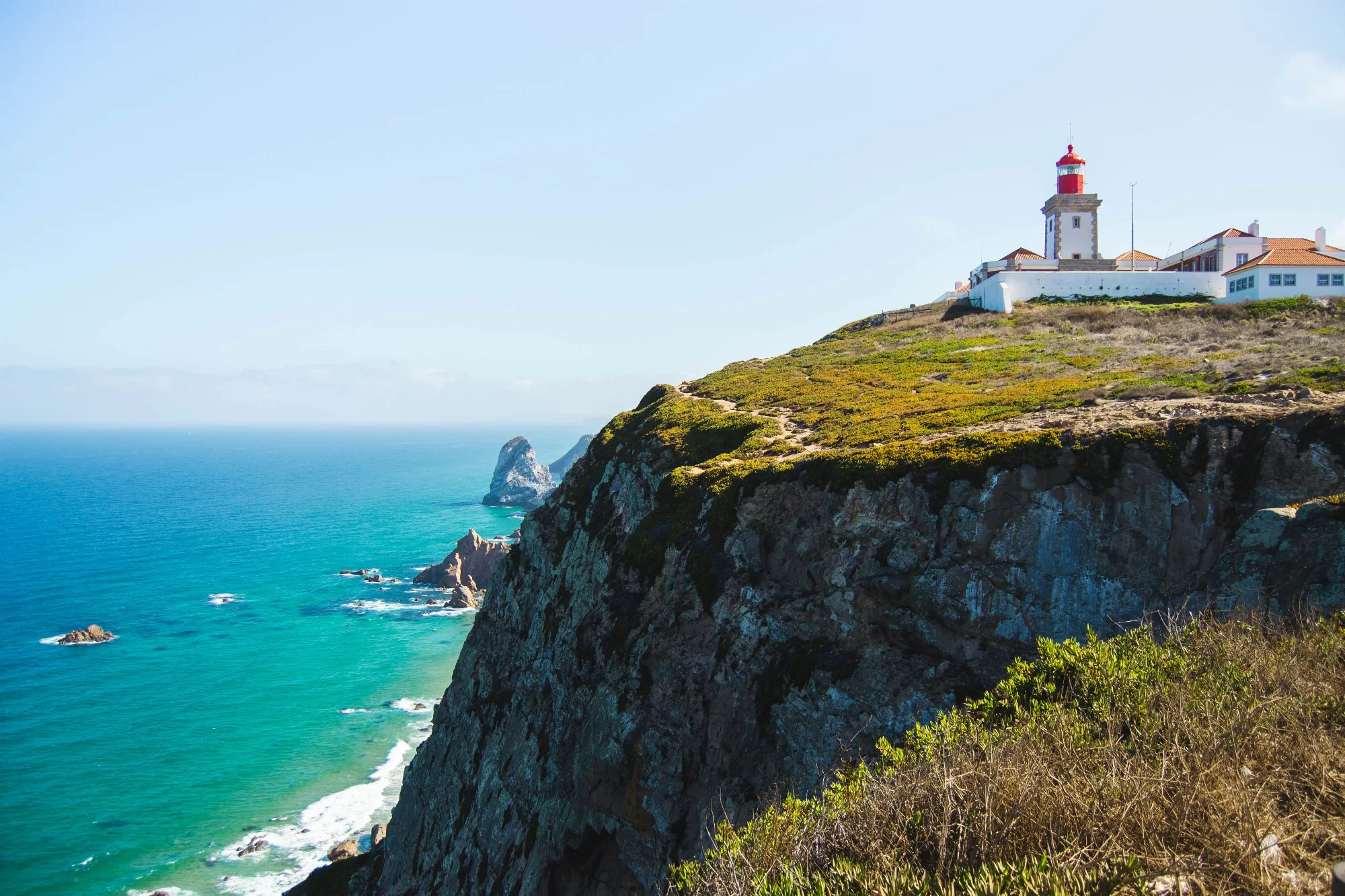
Cabo da Roca is the westernmost point of mainland continental Europe, set on high cliffs between Cascais and Sintra. The famous stone monument, lighthouse surroundings and Atlantic views occupy a fairly compact area. You do not need an entire day at the cape itself. Most visitors spend somewhere between a quick photo stop and a longer wander along the marked clifftop paths, depending on the wind and visibility.
The journey matters because Cabo da Roca is not in a town centre with frequent connections in every direction. It is an exposed headland on the coastal road, and conditions can change quickly. Cascais may be sunny while the cape is hidden by low cloud or being hit by a strong northerly wind. Carry a layer even in summer, keep away from unprotected cliff edges, and do not cross barriers for a photograph. The ground near the cliffs can be loose and the drop is real.
Cabo da Roca is an easy place to reach badly: the right transport turns a windswept photo stop into one of the best days on the Lisbon coast.
Your wider plan should decide the transport. If Cabo da Roca is your only destination and you have time to work around a timetable, the bus may be enough. Fit cyclists can make the journey itself the main event. For travellers hoping to combine the cape with Pena Palace, Quinta da Regaleira or Sintra's historic centre, private transport removes several awkward changes and long waits.
Can you cycle from Cascais to Cabo da Roca?
Yes, but this is not the relaxed seafront ride many visitors picture when they think about renting a bike in Cascais. The first section towards Guincho is beautiful and comparatively approachable, following the Atlantic past Boca do Inferno and the open coastline. Beyond the Guincho area, the ride becomes hillier and shares more space with motor traffic. Wind is often the deciding factor: a strong headwind can make the outward climb far more demanding than the map suggests.
For confident riders, renting a bike gives the trip a sense of scale that disappears behind a car window. You feel the change from Cascais resort streets to dunes, forested slopes and exposed cliffs. A good-quality e-bike is the sensible choice for most visitors attempting the full route. It takes the sting out of the climbing while still leaving you free to stop at viewpoints. A standard hybrid or road bike suits experienced cyclists who are comfortable with hills, traffic and changing coastal weather.
If you'd rather skip the parking and the timing altogether, this is exactly the kind of day our driver-guides run regularly.
See Private Tours →Start early enough to avoid rushing, and plan to return by bike rather than assuming you can load it onto a public bus. Carry water and a charged phone, because services become sparse outside Cascais and Guincho. Lights and a helmet are sensible even during the day, while a windproof layer is far more useful than a bulky winter coat. Riders who have not cycled recently should turn the outing into a shorter coastal ride to Guincho instead; Cabo da Roca is not a good place to discover that your confidence disappears on busy, climbing roads.
- Best for: fit, confident riders who want the journey to be part of the experience.
- Choose an e-bike if: you ride occasionally, want help on the climbs or expect a headwind.
- Avoid this option if: you are travelling with very young children, dislike riding near traffic or have uncertain weather.
- Do not rely on: taking a rental bike back to Cascais on a bus unless both the operator and rental provider have confirmed that arrangement.
How practical is the public bus to Cabo da Roca?
The bus is the cheapest realistic Cabo da Roca transport from Cascais, and it can work well for travellers who are not in a hurry. Services run through the coastal area connecting Cascais, Cabo da Roca and Sintra, but frequencies and route details can change. There may be substantial gaps, particularly outside the busiest periods, so check the current operator timetable shortly before travelling rather than relying on an old blog post or screenshot.
The main compromise is flexibility. If you arrive just after a bus departs, a short visit can turn into a long wait at an exposed stop. Buses may also be busy during summer and on clear weekends. Leave breathing room around dinner reservations, palace entry times and the final connection back to Cascais. The cape is not the place to build an itinerary around a narrow five-minute transfer.
Using buses for both Cabo da Roca and Sintra is possible, but it requires more planning than the short distances imply. You need to match the Cascais departure with your stop at the cape, continue towards Sintra, and then deal with local transport around the town's steep, scattered attractions. Timed palace tickets add another fixed point. This route is best for budget travellers who are content to visit one major Sintra sight rather than squeezing several monuments into the same day.
This is one of the routes our driver-guides know particularly well, if you'd rather sit back and let someone else handle the day.
Explore Tours →Does hiring a car make the day easier?
A rental car gives you control over departure time, photo stops and how long you stay at Cabo da Roca. It is particularly useful for families carrying pushchairs or extra layers, and for travellers staying outside central Cascais. The coastal drive is scenic, though the road can feel narrow and busy in places. Allow more time than a navigation app's ideal estimate, especially in summer.
The weakness appears when you add Sintra. Parking near Cabo da Roca can become congested at popular times, while driving and parking around Sintra are considerably more frustrating. Access arrangements around the historic centre and major monuments can change, roads are tight, and parking close to the attraction you want is not guaranteed. A car that feels liberating on the coast can become an expensive object you spend half the afternoon trying to place.
If you already have a rental car for a wider Portugal trip, using it for Cabo da Roca is reasonable. Hiring one solely for this day is less convincing once collection time, fuel, parking and insurance are considered. A practical approach is to visit the cape early, park outside Sintra's busiest core and use local transport where necessary. Do not leave luggage, passports or visible bags in the vehicle at remote viewpoints.
Why is a private tour best for Cabo da Roca and Sintra?
A private tour is the most convenient answer for travellers asking how to visit Cabo da Roca and Sintra in one trip. The advantage is not simply a comfortable vehicle. It is the ability to shape the day around weather, palace entry times and traffic. If Cabo da Roca is clear in the morning but cloud is building over the coast, the route can prioritise the viewpoint. If timed monument tickets dictate the schedule, the cape can fit naturally before or after them.
A private tour covers this route without you having to think about logistics — just show up and go.
Book a Tour →You also avoid coordinating separate bus networks, searching for parking and deciding which Sintra roads are practical. Pickup in Cascais saves the first connection, while direct travel between the cape and Sintra protects more of the day for the places you came to see. This is especially valuable for families, small groups, visitors with limited mobility and anyone with only one free day on the Lisbon coast.
Before choosing a private tour, read what is actually included. Some experiences provide a driver and flexible transport; others include active guiding and historical interpretation. Monument tickets, meals and entry reservations may be separate. Ask whether the itinerary is private to your group, how much time is planned at Cabo da Roca, and which Sintra monument can realistically be visited without turning the day into a race. A sensible combination is the cape, Sintra's old centre and one major palace or estate. Two headline monuments may work with careful timing, but adding every famous stop usually means seeing most of them through a window.
- Choose the bus for the lowest cost and a simple cape visit with a flexible schedule.
- Choose a rental car if you already have one and are comfortable handling parking outside central Sintra.
- Choose a private tour when comfort, limited time and combining Cabo da Roca with Sintra matter most.
There is no poor way to see the Atlantic from Cabo da Roca, but there are poor ways to organise the day. Strong cyclists should consider an e-bike and make the wild coastal road part of the experience. Budget travellers can use the bus if they check the latest schedule and resist overfilling the itinerary. For a single day covering Cabo da Roca from Cascais and the best of Sintra, a private tour offers the smoothest route and the most useful commodity of all: time where you want it, rather than time spent waiting or parking.